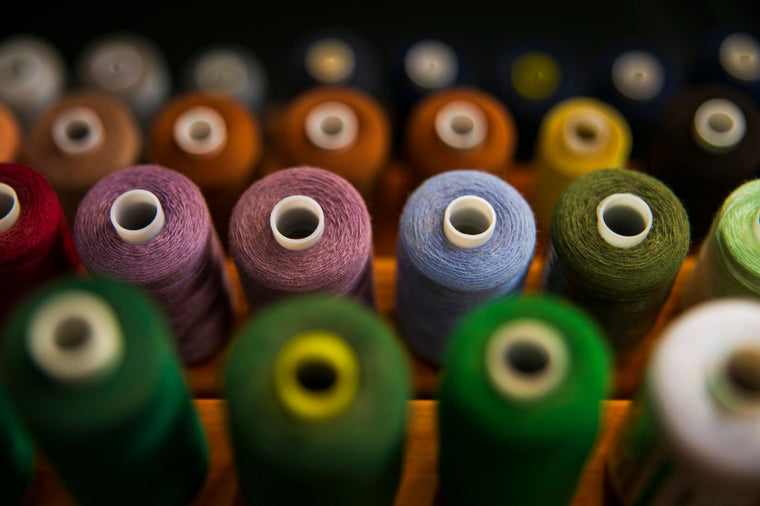
If you have ever carried fabric to the window and judged three nearly identical beige threads like they were finalists, this guide is for you. To match sewing thread colour to fabric, compare the thread directly against the fabric in natural light, choose the shade that blends from a normal viewing distance, and test a short stitch line if you are unsure. If two shades are close, the slightly darker thread is usually safer than the lighter one.
You are not being dramatic — thread colour matching really does become obvious only when the wrong colour is already stitched into the seam.
This guide shows you how to choose a sewing thread colour for solids, prints, repairs, topstitching, and online thread buying. STI Ideal has supplied sewing thread since 1999, with thousands of colours and over 60 million spools sold, so we care deeply about this tiny but mighty decision.
Match the thread to the fabric itself
Start with the fabric in front of you. Do not choose thread from memory, a product photo, or the colour you wish the fabric was. Fabric colour changes under different lighting, and screens can make colours warmer, cooler, brighter, or flatter.
Use this process:
- Place the fabric flat in natural light.
- Pull a short length of thread from the spool.
- Lay the loose thread across the fabric, not just beside it.
- Step back and check whether the thread disappears.
- Repeat with the closest alternatives.
Loose thread is easier to judge than thread wound tightly on a spool. The spool can look darker or denser than the thread will look when stitched.
Test a few stitches before you commit
If you have time, stitch a short test line on a fabric scrap. A thread that looks good on the spool may behave differently once it is sewn.
Look at the test seam from close up, at arm's length, in natural light, in indoor light, and from the side where the stitching will show. For seams that will be hidden, a close match is usually enough. For topstitching, repairs, or visible hems, test stitching matters more.
When in doubt, go slightly darker
If two thread colours are close, the slightly darker one often blends better. Lighter thread tends to sit on top visually and catch the eye, especially on medium and dark fabrics.
Use the darker-shade rule for hems, alterations, garment seams, repair stitching, and topstitching that should stay quiet. There are exceptions: if you want decorative contrast, choose contrast on purpose. But if your goal is a clean sewing thread colour match, darker is usually more forgiving.
Match prints by the most visible colour
Printed fabric is not asking you to match every colour, so take the pressure off. For prints, choose the thread based on where the stitching will show most:
- Match the background colour if the fabric has a clear base.
- Match the darkest recurring colour if the print is busy.
- Match the fabric area closest to the seam or hem.
- Use grey, beige, navy, or another neutral if no single colour dominates.
If the stitching crosses many colours, a neutral thread may blend better than a perfect match to only one part of the print.
Use contrast thread only when you mean it
Contrast thread can look beautiful. It can also announce every wobble in your stitch line. Use contrast thread when the stitching is decorative, when you want visible topstitching, when the seam line is neat and intentional, or when the contrast supports the design. Avoid it when you want repairs, hems, or construction seams to disappear.
Match thread online with a fabric photo
Online thread buying is harder because you cannot hold the spool beside your fabric. This is where a fabric photo colour matcher helps. STI Ideal's fabric photo colour matcher helps customers find the closest available STI Ideal shade — especially useful when choosing from thousands of colours and building a Custom Thread Box.
For better results, photograph fabric in natural light, avoid shadows and filters, photograph the fabric area you want to match, and use the result as a close-match guide rather than an exact guarantee. The key phrase is closest available shade. Fabric texture, dye lots, screens, and lighting can all affect colour.
Build a small set of reliable thread colours
You do not need every colour at once. You need the colours your projects actually use. A thread box is not clutter — it is emotional preparedness. A useful 10-spool box might include:
- White or off-white
- Cream or beige
- Light grey
- Dark grey or black
- Navy
- Two current project colours
- Two repair shades
- One fabric-matched shade
Each STI Ideal Custom Thread Box contains 10 spools of 40/2 polyester sewing thread. Each spool is 400 yards, approximately 366 metres. Customers can choose one shade or mix up to five colours in a box. For a full walk-through, see how to build a useful 10-spool thread box.
Quick checklist
Before choosing thread colour, ask:
- Is the fabric solid or printed?
- Will the stitching be hidden or visible?
- Should the thread blend or contrast?
- Have I checked the thread in natural light?
- Does the slightly darker shade blend better?
- Would a fabric photo colour matcher help narrow the choice?
Frequently asked questions
Should thread be lighter or darker than fabric?
If the thread should blend in, slightly darker is often safer than lighter. Lighter thread can stand out on seams, while darker thread usually recedes.
How do I match thread to printed fabric?
Match the background colour, the darkest recurring colour, or the area where the stitching will show most. For busy prints, a neutral shade can work better than chasing every colour.
Can I use a different colour thread on purpose?
Yes. Contrast thread works well for decorative topstitching, but it will make stitching more visible. Use it when the visible line is part of the design.
Can a fabric photo match thread exactly?
No tool can guarantee an exact match from every photo. STI Ideal's fabric photo colour matcher helps find the closest available shade.
How many colours can I choose in an STI Ideal Custom Thread Box?
You can choose one shade or mix up to five colours. Each box contains 10 spools.
Build your box
Once you have your matches, you can choose your sewing thread colours and have them boxed together — 10 spools in one shade or a mix of up to five, from thousands of colours in 40/2 polyester. Not sure where to start? Upload a fabric photo and let the colour matcher suggest the closest available shades, or browse the full range in our catalogue.